How to use the decking calculator
- Enter the deck length in the direction the boards will run, and the width across them. Together they give the decking area.
- Enter the board width and gap. A typical UK board is 144 mm with a 5 mm gap. In the US, a 5/4 × 6 board is 5.5 in.
- Enter the board length you will buy: 2.4, 3.0, 3.6 or 4.8 m in the UK, or 8 to 20 ft in the US. Pick a length that divides your deck neatly to cut waste.
- Set the joist spacing, usually 400 mm (16 in).
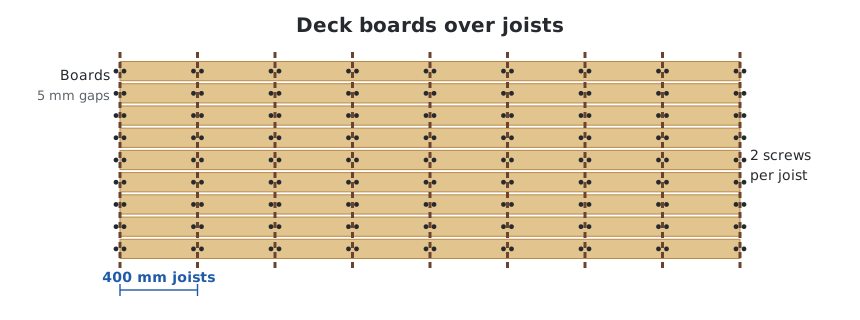
- The plan view shows each row of boards and the joists underneath, so you can check the layout.
How many deck boards do I need?
Rows = deck width ÷ (board width + gap), rounded up
Boards = rows × deck length × (1 + waste) ÷ board length, rounded up
Worked example: a 4 × 3 m deck with boards running along the 4 m side. 3,000 mm ÷ 149 mm = 20.1, so 21 rows. 21 × 4 m = 84 m of board, or 92.4 m with 10% waste, which is 26 boards of 3.6 m. Joists at 400 mm centres across the 4 m length need 11 joists, each 3 m long, and 21 × 11 × 2 = 462 screws.
In feet: a 12 × 16 ft deck with 5.5 in boards and 3/16 in gaps has 34 rows, 408 ft of board, so 38 boards of 12 ft with 10% waste, 10 joists and 680 screws.
Joist spacing
| Decking | Joist centres |
|---|---|
| Timber boards, 28 mm (1 in), square to joists | 400 mm (16 in) |
| Thicker timber boards, 32 mm and up | up to 500 mm, per maker |
| Timber boards laid at 45° | 300 mm (12 in) |
| Composite boards | 300–400 mm (12–16 in), per maker |
| Thicker 2 × 6 timber (US) | up to 24 in in some cases, per local code |
Joist size depends on the span between bearers or beams. In the UK, pressure-treated 47 × 150 mm C16 or C24 joists are common for ground-level decks. Raised decks, and decks in places with building codes, may need engineered spans. This calculator counts joists and boards. It does not size the structure.
Board length and waste
Waste is lowest when the deck length is a multiple of the board length. A 3.6 m deck with 3.6 m boards has no joins. A 4 m deck needs a join on every row, so offcuts pile up. Stagger the joins and make sure each one lands on a joist, doubling the joist at joins if needed. Keep 10% extra for cuts and rejected boards.
Do I need planning permission for decking?
In England, decking counts as permitted development as long as it is no more than 30 cm above the ground and, with other extensions and outbuildings, covers no more than half the garden. Raised decks, decks at listed buildings, and decks in conservation areas usually need planning permission. Rules differ in Scotland, Wales and Northern Ireland, and in other countries, so check with your local council first.
Fascia boards and finishing
Fascia (skirting) boards cover the cut ends of the joists around the edge of the deck. Add the deck perimeter to your order if you want them. Leave a 5–8 mm gap between boards for drainage, and keep the timber frame off the soil with a weed membrane and gravel, or on pads.
Tips
- Lay a weed membrane and gravel under ground-level decks, and keep timber off the soil.
- Pre-drill near board ends to stop splitting, and use exterior-rated or stainless deck screws.
- Turn the board's growth rings to face down (bark side up) for timber decking, unless the maker says otherwise.
Frequently asked questions
How many deck boards do I need?
Divide the deck width by the board width plus the gap to get the number of rows, multiply by the deck length to get the total board length, add 10% for waste and divide by the board length. A 4 × 3 m deck with 144 mm boards and 5 mm gaps needs 21 rows, 84 m of board, or 26 boards of 3.6 m.
How far apart should deck joists be?
400 mm (16 in) centres is standard for timber decking boards. Use closer spacing, around 300 mm (12 in), for boards laid diagonally and for some composite boards. Always check the board maker's maximum span.
How many screws do I need for decking?
Two screws per board at every joist. Multiply the number of board rows by the number of joists and by two. A 4 × 3 m deck with 21 rows and 11 joists needs 462 screws, so buy a box of 500.
What gap should I leave between deck boards?
About 5 mm (3/16 in) between timber boards to let water drain and allow for swelling. Composite boards often need a set gap given by the maker, sometimes with hidden clips.
What size are decking boards?
UK timber decking is commonly 120 to 150 mm wide (often 144 mm) and 28 to 32 mm thick, in 2.4, 3.6 and 4.8 m lengths. In the US, 5/4 × 6 boards (about 1 × 5.5 in) and 2 × 6 boards come in 8, 12, 16 and 20 ft lengths.