How to use the mortar calculator
- Pick your brick or block. The list covers standard UK, Australian and US sizes.
- Enter the wall length and height. Add up separate walls, or calculate each one and add the results.
- Leave out openings such as doors and windows by entering their total area.
- Choose single or double skin for brick walls. A double-skin (one-brick) wall uses twice the bricks.
- Pick the mix ratio and keep about 15% mortar waste to cover frogs, droppings and the board.
How many bricks per square metre?
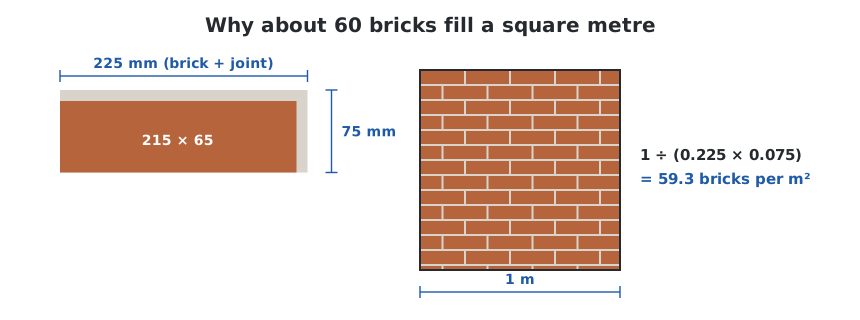
Each brick plus one joint covers (brick length + joint) × (brick height + joint). For a UK brick with 10 mm joints that is 0.225 × 0.075 m, so 1 ÷ 0.016875 = 59.3 bricks per m², usually rounded to 60.
| Unit | Size | Per m² | Per ft² | Mortar per m², before waste |
|---|---|---|---|---|
| UK brick | 215 × 102.5 × 65 mm | 59.3 | 5.5 | 0.018 m³ |
| Australian brick | 230 × 110 × 76 mm | 48.4 | 4.5 | 0.017 m³ |
| US modular brick | 7 5/8 × 3 5/8 × 2 1/4 in | 73.7 | 6.85 | 0.017 m³ |
| UK concrete block | 440 × 215 × 100 mm | 9.9 | 0.92 | 0.007 m³ |
| US concrete block | 8 × 8 × 16 in | 12.1 | 1.125 | 0.013 m³ |
How much mortar, cement and sand?
The mortar volume is the space the joints fill around each brick: the brick-plus-joint face minus the brick face, times the wall thickness. Like screed, dry sand and cement shrink when mixed, so the calculator uses 1.3 times the wet volume of dry material, split by your mix ratio.
Worked example: a 10 m² garden wall in UK brick, single skin, 1:4 mix. That is 593 bricks (623 with 5% spare) and about 0.2 m³ of mortar with 15% waste, which needs about 76 kg of cement (4 bags) and 0.34 tonnes of building sand. The same wall in 100 mm blocks needs 104 blocks and less than half the mortar.
Mortar mix ratios
- 1:3 cement to sand: strong mortar for below the damp-proof course, retaining walls and engineering bricks.
- 1:4: general brickwork and blockwork above ground.
- 1:5 to 1:6: softer mortar for internal walls and soft or reclaimed bricks, often with lime or a plasticiser added for workability.
Use building (soft) sand for mortar, not sharp sand, which is for screeds and concrete.
Many builders use a cement, lime and sand mix such as 1:1:6, where the lime makes the mortar more workable and a little flexible. For the calculator, enter the cement-to-sand ratio and treat the lime as part of the sand. Ready-mixed and bagged mortars are made to BS EN 998-2 and labelled by strength class instead of ratio.
Mortar strength and frost resistance
Each mortar mix ratio gives a different strength. Ready-mixed mortars to BS EN 998-2 are sold by compressive strength class instead, in newtons per square millimetre (N/mm²). Roughly:
| Class | Compressive strength | Similar site mix | Typical use |
|---|---|---|---|
| M12 | 12 N/mm² | 1 : 0–¼ : 3 | Below ground, retaining walls, engineering bricks |
| M6 | 6 N/mm² | 1 : ½ : 4–4½ | Exposed walls, garden walls, chimneys |
| M4 | 4 N/mm² | 1 : 1 : 5–6 | General house walls above the damp-proof course |
| M2 | 2 N/mm² | 1 : 2 : 8–9 | Internal walls, soft bricks |
Stronger mortars have better frost resistance, so use M6 or M12 for walls that get soaked and frozen, such as garden walls, copings and anything below the damp-proof course. Mortar shouldn't be much stronger than the bricks themselves, so weak, soft or reclaimed bricks need a softer mix. The calculator estimates quantities for whichever mortar mix ratio you choose. It doesn't check strength, so pick the class for the job first.
How long does mortar take to set?
Mortar is workable for about two hours after mixing. It sets firm in 24–48 hours, enough to carry the next courses, and reaches full strength after about 28 days. Protect fresh brickwork from frost and heavy rain for the first few days.
Brick bonds
The calculator assumes stretcher bond, where every brick shows its long face, as in a half-brick (single-skin) wall. Flemish and English bond walls are a full brick thick, so choose double skin. A one-brick wall uses about 120 bricks per m² whatever the bond.
Tips
- Mix only what you can use within about two hours, before the mortar starts to set.
- Keep joints a steady 10 mm (3/8 in). Thicker joints use more mortar and look uneven.
- Check whether your bricks are laid frog up. Filling frogs adds noticeably to the mortar.
Frequently asked questions
How many bricks are in a square metre?
About 60 UK bricks (215 × 65 mm with 10 mm joints) per square metre of single-skin wall, and about 120 for a double-skin wall. Concrete blocks (440 × 215 mm) are about 10 per square metre.
How much mortar do I need for 1,000 bricks?
About 0.34 m³ of wet mortar with 15% for waste and frogs, which at a 1:4 mix is about 5 bags of cement (25 kg) and 0.57 tonnes of building sand. Bricks laid frog up, or with wider joints, use more.
What is the best mortar mix ratio?
1 part cement to 4 parts building sand is a good general mix for brickwork above ground. Use 1:3 below the damp-proof course and for retaining walls, and 1:5 or 1:6 (often with lime or plasticiser) for internal walls and soft bricks.
How many bricks are in a square foot?
About 6.75 US modular bricks per square foot of wall with 3/8 inch joints, and about 1.125 standard 8 × 16 inch concrete blocks per square foot.
How much extra brick should I order?
Order about 5% extra for breakages and cuts, more for walls with many corners or openings. The calculator already adds 5% to the number of bricks or blocks.