How to use the fence calculator
- Measure the fence line from the outside of the first post position to the outside of the last. Use a tape or a string line pegged at each end.
- Enter the fence height above the ground and the panel width. UK panels are 1.83 m (6 ft) wide. In the US, enter your post spacing, usually 8 ft.
- Enter the post width: 75 or 100 mm for timber posts, 100 mm for slotted concrete posts, or 3.5 in for a US 4x4.
- Set how many bags of postcrete or concrete you use per post. Two is typical for a 6 ft fence.
- The drawing shows your run to scale and tells you how much to cut off the last panel if the length isn't an exact fit.
How many fence panels and posts do I need?
Each panel sits between two posts, so a straight run always needs one more post than panels. Because posts take up space too, divide the length by the panel width plus one post width:
Panels = (fence length − post width) ÷ (panel width + post width), rounded up
Posts = panels + 1
Worked example: a 20 m garden boundary with 1.83 m panels and 100 mm posts. (20 − 0.1) ÷ 1.93 = 10.3, so you need 11 panels and 12 posts. Eleven panels cover 11 × 1.83 + 12 × 0.1 = 21.33 m, so the last panel is cut down by 1.33 m. Many people choose 10 full panels and fill the gap with a cut panel or a gate.
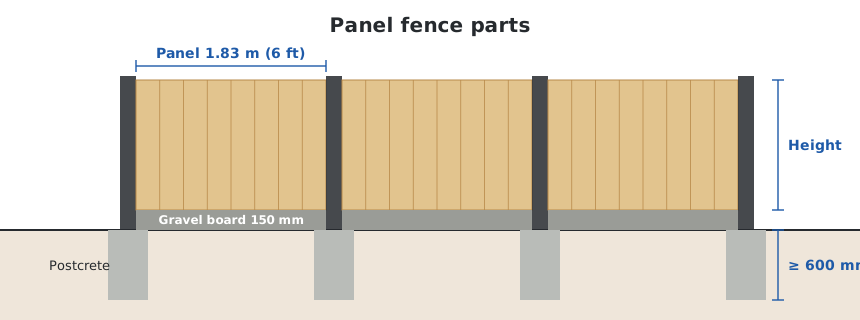
Standard fence panel sizes
| Panel height | Panel width | Post length on a gravel board | Without gravel board | Postcrete per post |
|---|---|---|---|---|
| 3 ft (0.91 m) | 6 ft (1.83 m) | 6 ft (1.8 m) | 5 ft (1.5 m) | 1 bag |
| 4 ft (1.22 m) | 6 ft (1.83 m) | 7 ft (2.1 m) | 6 ft (1.8 m) | 1–2 bags |
| 5 ft (1.52 m) | 6 ft (1.83 m) | 8 ft (2.4 m) | 7 ft (2.1 m) | 2 bags |
| 6 ft (1.83 m) | 6 ft (1.83 m) | 9 ft (2.7 m) | 8 ft (2.4 m) | 2 bags |
Closeboard and featheredge fences are built in bays rather than panels. Use your post spacing (usually 2.4 to 3 m) as the panel width.
How deep should fence posts go?
A good rule is to bury about a quarter of the post, and never less than 600 mm (2 ft). Taller fences catch more wind, so in exposed gardens or soft ground go deeper, to about a third.
A 6 ft panel on a 150 mm gravel board stands about 1.98 m tall, so it needs a 9 ft (2.7 m) post to leave about 700 mm in the ground. Without a gravel board, an 8 ft (2.4 m) post leaves about 600 mm buried. The calculator rounds up to the next standard post length. Where the ground freezes, local codes set the minimum depth below the frost line.
Dig each hole about three times the width of the post, so a 100 mm post sits in a hole roughly 300 mm across.
How much postcrete do I need?
Fast-setting post mix (postcrete) comes in 20 kg bags in the UK. Allow about two bags per post for a 6 ft fence, and one for fences of 4 ft and under. In firm, compact ground one bag can be enough even for a 6 ft fence, while soft or sandy ground needs two or more. In the US, fast-setting concrete comes in 50 lb bags, and two per post is a common allowance for a 6 ft privacy fence. Large holes, sandy soil or concrete posts need more. Buy a spare bag, since unused bags keep if they stay dry.
Gravel boards, rails and pickets
- Gravel boards (UK) are 150 mm concrete or timber boards fitted under each panel to keep it off wet soil. You need one per panel.
- Rails (US) run between posts to carry the pickets. Use 2 rails per section for fences up to about 4–5 ft and 3 for a 6 ft fence.
- Pickets (US): the number per section is the section width divided by the picket width plus any gap. A privacy fence has no gap. A spaced picket fence usually has a gap equal to about half a picket.
Fence panel types
- Lap or overlap panels: the cheapest option, horizontal boards overlapping each other. Fine for most garden boundaries.
- Closeboard (featheredge): vertical boards nailed to rails, the strongest and most private. Usually built in bays, so use your post spacing as the panel width.
- Hit and miss: boards alternate on each side of the rails. It lets wind through, so it suits exposed gardens.
- Slatted and contemporary panels: horizontal slats with gaps. Check the maker's width, as many are 1.8 m rather than 1.83 m.
Heavy-duty panels and slotted concrete posts last longest. Timber posts look better and are easier to cut, and post caps keep rain out of the end grain.
Tips before you buy
- Check your boundary and any height limits first. In England, fences over 2 m (or 1 m next to a road) usually need planning permission.
- Split L-shaped or gated fences into straight runs, and count corner and gate posts once.
- On a slope, step the panels down rather than following the slope, and allow longer posts on the low side.
- Treated softwood posts last far longer than untreated ones. Concrete posts last longest of all.
Frequently asked questions
How many fence panels do I need?
Divide the fence length by the panel width plus one post width, and round up. For a 20 m run of 1.83 m panels with 100 mm posts that is (20 − 0.1) ÷ 1.93 = 10.3, so 11 panels and 12 posts, with the last panel cut to fit.
How many posts do I need for a fence?
One more post than panels. Each panel sits between two posts, so a straight run of 10 panels needs 11 posts. Add an extra post for every corner or gate if the run is split.
How deep should fence posts be?
Set roughly a quarter to a third of the post in the ground, and never less than 600 mm (2 ft). A 1.8 m (6 ft) panel uses 2.4 m (8 ft) posts on its own, or 2.7 m (9 ft) posts when it sits on a 150 mm gravel board.
How many bags of postcrete per fence post?
Allow about two 20 kg bags of postcrete per post for a 6 ft fence, and one bag for low fences of 3 to 4 ft. Wider holes, soft ground or concrete posts take more.
What size are standard fence panels?
In the UK the standard panel is 6 ft (1.83 m) wide and comes in heights of 3, 4, 5 and 6 ft. In the US, wood fence sections are usually built with posts 8 ft on center.
Do I need gravel boards?
Gravel boards are 150 mm boards fitted under each panel to keep it off the soil, so the panel does not rot. They are optional but make a fence last longer, and you need one per panel.