How to use the firewood cord calculator
- Measure the stack length from end to end in feet. For a stack with sloping ends, measure at mid-height.
- Measure the height at three or more spots along the pile and type the average. Wood settles, and the middle of a pile is often lower than the ends.
- Measure several pieces and enter the average piece length (log length) in inches. That is the depth of the stack.
- Add the price you paid to convert any quote (face cord, rick, half cord, truckload) into a price per full cord.
- The drawing shows your stack against the dashed outline of a full cord face (8 × 4 ft) so you can see the difference at a glance.
How big is a cord of wood?
A full cord is 128 cubic feet of firewood stacked tightly: traditionally 4 feet high, 4 feet deep (or wide) and 8 feet long. Any stack whose length × height × depth equals 128 cubic feet is a cord, so a pile 16 feet long, 4 feet high and two 12-inch pieces deep is also one cord. In metric terms a cord is about 3.62 cubic meters.
Cords = length (ft) × height (ft) × piece length (ft) ÷ 128
Multiplying the three measurements gives the total volume in cubic feet. Dividing by 128 turns that into cords.
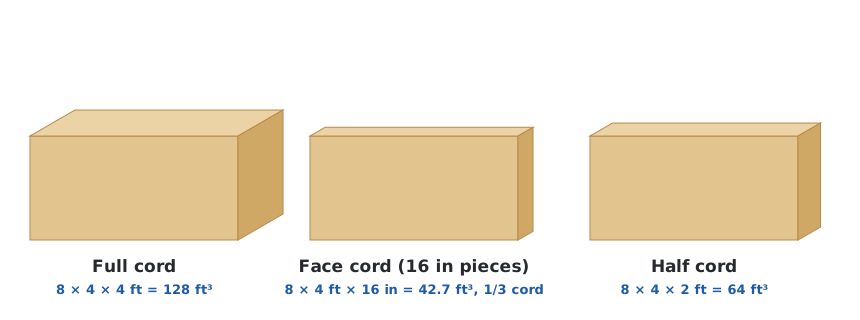
Face cord, rick, half cord: firewood measurements compared
Sellers use many names, and only some of them are fixed amounts. The key is depth: a face cord or rick is always 4 × 8 ft on the face, but the amount of wood it holds depends on the piece length.
| Unit | Typical size | Cubic feet | Share of a cord |
|---|---|---|---|
| Full cord | 8 × 4 × 4 ft | 128 | 1 |
| Half cord | 8 × 4 × 2 ft | 64 | 1/2 |
| Face cord, 24 in pieces | 8 × 4 ft × 24 in | 64 | 1/2 |
| Face cord or rick, 16 in pieces | 8 × 4 ft × 16 in | 42.7 | 1/3 |
| Face cord, 12 in pieces | 8 × 4 ft × 12 in | 32 | 1/4 |
| Quarter cord | 4 × 4 × 2 ft | 32 | 1/4 |
| Bundle (store bag) | about 0.75 ft³ | 0.75 | about 1/170 |
Many US states follow the national model rule that firewood sold in bulk must be measured in cords or fractions of a cord. Under that rule, terms like rick, face cord, run or truckload don't define a legal amount. If a seller quotes in those terms, ask for the stack dimensions and run them through the calculator.
Stacked vs loose firewood
The 128 cubic foot cord assumes stacked firewood: pieces laid tightly in a row, parallel to each other. Wood thrown loosely into a truck or pile has far more air between the pieces.
A common rule of thumb is that a cord of loose, thrown firewood fills about 180 cubic feet. The calculator uses that figure when you choose Thrown loose. Because loose volume varies with piece size and shape, stack the wood when you need an exact answer. Neat stacks of wood are also how sellers and weights-and-measures inspectors check a delivery.
Even in a perfect stack, a cord is not 128 cubic feet of solid wood. Depending on how straight and split the pieces are, a cord holds roughly 70 to 90 cubic feet of actual wood. The rest is air space, the gaps between round, crooked and knotty pieces. Loosely stacked wood has bigger air gaps, so it holds even less.
How many cords fit in a pickup truck?
- Long bed (8 ft): about ½ cord stacked tightly to the top of the bed rails, or about ⅓ cord thrown in loose.
- Standard bed (6½ ft): a little under ½ cord stacked, about ¼ to ⅓ cord loose.
- Short bed (5½ ft): about ⅓ cord stacked.
So a delivery described as a "truckload" is usually well short of a full cord. Measure it once stacked.
Checking the price per cord
Firewood prices vary by species, dryness, region and whether delivery and stacking are included. Comparing quotes only works on the same unit. For example, $150 for a face cord of 16-inch pieces is $450 per full cord, while $300 for a half cord is $600 per full cord. Enter the price paid and the calculator does this conversion for you, including for oddly sized stacks.
How much does a cord of wood weigh?
Weight depends on species and on how much water is still in the wood. A cord of seasoned hardwood such as oak, hickory or maple typically weighs about 2,000 to 3,500 pounds. The same cord green (freshly cut) can weigh 4,000 to 5,000 pounds, because fresh wood can be half water by weight. Softwoods like pine are lighter, usually under 2,500 pounds seasoned. Most half-ton pickups are rated for roughly 1,500 to 2,000 pounds of payload, so even half a cord of green oak can overload one.
Seasoned vs green firewood: moisture content
Seasoned firewood has dried to about 20% moisture content or less, which is what you want for a clean, hot fire. Split wood stacked off the ground with the top covered usually takes 6 to 12 months to season. Dense hardwoods like oak can take up to two years. Kiln dried firewood is dried in a kiln to below 20% in days.
Green wood burns poorly, smokes, and builds creosote in the chimney. It also shrinks a little as it dries, so a stack of green wood measured today will be slightly smaller once seasoned. A cheap moisture meter, pushed into a freshly split face, tells you which you have.
How many cords of firewood do I need for winter?
Your firewood needs, the amount of firewood you burn in a season, depend on your climate, house size and insulation, and how efficient your stove is. As a rough guide:
- Occasional fires in a fireplace: ½ to 1 cord a season.
- Supplemental heat from a wood stove: 1 to 3 cords.
- Primary heat in a cold climate: 3 to 6 cords or more.
An open fireplace sends most of its heat up the chimney. A modern EPA-certified stove gets far more heat from the same cord, so the stove matters as much as the house.
Heat per cord by wood species
Dense wood holds more energy per cord. Approximate heat content for air-dried wood:
| Group | Examples | Million BTU per cord |
|---|---|---|
| Dense hardwoods | Hickory, oak, ash, beech, sugar maple | about 24–28 |
| Medium hardwoods | Cherry, birch, elm, red maple | about 18–22 |
| Softwoods and light hardwoods | Pine, spruce, poplar, cottonwood | about 14–17 |
So a cord of oak at the same price is better value than a cord of pine. Compare price per cord and species together. A full cord of 16-inch split wood also holds roughly 600 to 800 pieces, depending on how finely it is split.
Tips for measuring a woodpile
- Measure after the wood is stacked, not while it is still in the truck.
- Take height readings at the ends and in the middle. Use the average, not the tallest point.
- Measure five or six random pieces. Firewood cut "16 inches" often runs 14 to 18.
- If the stack leans or has gaps you could put a fist through, expect less wood than the numbers say.
Frequently asked questions
How much is a cord of wood?
A cord is 128 cubic feet of firewood stacked tightly, usually a pile 8 feet long, 4 feet high and 4 feet deep. Price depends on species, how dry the wood is, delivery distance and region, so compare quotes by the price per full cord.
How big is a cord of wood?
A full cord measures 4 ft high × 4 ft deep × 8 ft long, which is 128 cubic feet. Any stack whose length × height × depth equals 128 cubic feet is also a cord, for example 16 ft long × 4 ft high × 2 ft deep.
What is a face cord of wood?
A face cord is a stack 4 ft high and 8 ft long, one piece deep. With 16-inch pieces it is one third of a full cord (about 42.7 cubic feet). With 12-inch pieces it is one quarter of a cord, and with 24-inch pieces it is half a cord.
Is a rick the same as a face cord?
In most places a rick means the same as a face cord: 4 ft by 8 ft, one row of pieces deep. Because the depth is not fixed, rick and face cord are not legal units of sale in many US states. Ask the seller for the piece length, or buy by the cord.
How many face cords are in a full cord?
With the usual 16-inch firewood there are three face cords in a full cord. With 12-inch pieces there are four, and with 24-inch pieces there are two. Divide 48 by your piece length in inches.
How many cords fit in a pickup truck?
An 8 ft long bed holds roughly half a cord stacked tightly to rail height, or about a third of a cord thrown in loose. A 6½ ft bed holds a little less than half a cord stacked.
How do I measure a stack of firewood?
Measure the length of the stack, the height at three or more points along it, and the length of a few pieces. Average the heights and piece lengths, multiply length × height × depth in feet, and divide by 128 to get cords.
How much does a cord of wood weigh?
A cord of seasoned hardwood such as oak or maple typically weighs about 2,000 to 3,500 pounds. Green wood can weigh 4,000 to 5,000 pounds per cord because it still holds a lot of water. Softwoods like pine are lighter.
How many cords of wood do I need for winter?
About ½ to 1 cord for occasional fireplace fires, 1 to 3 cords for supplemental heat from a wood stove, and 3 to 6 cords or more if wood is your main heat in a cold climate.