How to use the screed calculator
- Choose the screed type. Sand and cement is mixed on site. Liquid (anhydrite or flowing) screed is delivered and pumped, and ordered by volume.
- Measure the floor length and width wall to wall. Split L-shaped rooms into rectangles.
- Enter the screed depth, the finished thickness from the slab or insulation to the top of the screed.
- Pick the mix ratio. 1:4 cement to sharp sand is the usual floor screed.
- Keep a waste allowance of 10% for uneven slabs, spillage and the mix left in the mixer.
How much screed do I need? The formula
Screed volume (m³) = length (m) × width (m) × depth (mm) ÷ 1,000
A sand and cement mix shrinks as water fills the gaps between the grains, so you need more dry material than the wet volume. The calculator adds 30% (a factor of 1.3) to get the dry volume, then splits it by your mix ratio. Cement is taken at 1,440 kg/m³ and damp sharp sand at 1,600 kg/m³.
Worked example: a 5 × 4 m kitchen (20 m²) screeded 65 mm deep over insulation. 20 × 0.065 = 1.3 m³, or 1.43 m³ with 10% waste. The dry volume is 1.86 m³. At 1:4 that is about 535 kg of cement (22 bags of 25 kg) and 2.4 tonnes of sharp sand, so three 850 kg bulk bags.
Cement and sand per square metre
| Depth | Wet volume | Cement | Sharp sand | Typical use |
|---|---|---|---|---|
| 25 mm | 0.025 m³ | 9.4 kg | 42 kg | Bonded screed |
| 40 mm | 0.040 m³ | 15 kg | 67 kg | Bonded screed |
| 50 mm | 0.050 m³ | 18.7 kg | 83 kg | Unbonded on a membrane |
| 65 mm | 0.065 m³ | 24.3 kg | 108 kg | Floating over insulation, underfloor heating |
| 75 mm | 0.075 m³ | 28.1 kg | 125 kg | Commercial floating screed |
Screed mix ratios
The British Standard for screeds, BS 8204, puts sand and cement floor screeds at 1:3 to 1:4.5 cement to sharp sand by volume. 1:4 is the everyday choice for domestic floors. Use clean sharp (concreting) sand, not soft building sand, which shrinks and cracks. Add only enough water for a semi-dry, "earth damp" mix that holds together when squeezed. Too much water weakens the screed and makes cracking more likely.
How thick should a screed be?
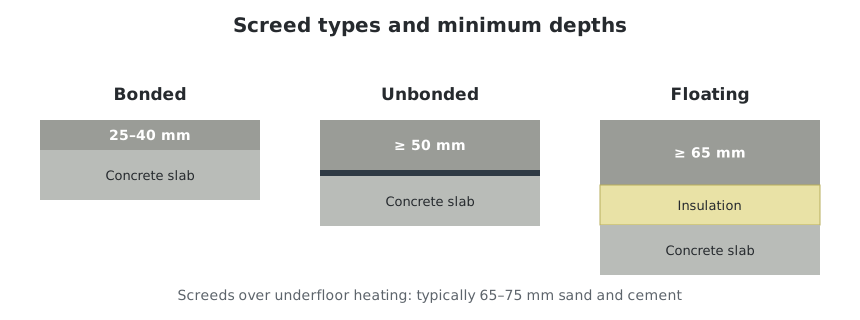
- Bonded (stuck to a clean concrete slab with a bonding agent): 25–40 mm.
- Unbonded (on a damp-proof membrane): at least 50 mm.
- Floating (on rigid insulation): at least 65 mm in homes, 75 mm in commercial buildings.
- Over underfloor heating: typically 65–75 mm of sand and cement, with at least 25 mm of screed over the top of the pipes. Liquid screeds can be thinner. Follow the system maker's figure.
Sand and cement vs liquid screed
Traditional screed is cheap and can be laid in small areas by hand, but it is heavy work and slow to dry. Liquid screed (usually calcium sulphate or anhydrite) flows level, can be laid thinner over insulation and underfloor heating, and is pumped in by the supplier. It is ordered in cubic metres, which is the volume the calculator shows. Most suppliers have a minimum order of a few cubic metres.
Drying time
A common rule for sand and cement screed is about one millimetre per day for the first 40 mm, then about half a millimetre per day after that. That means a 65 mm screed can need two to three months before timber, vinyl or other moisture-sensitive floors go down. Test with a hygrometer before laying the floor finish. Liquid screeds can be force-dried with underfloor heating after about a week, following the maker's schedule.
Frequently asked questions
How much screed do I need?
Multiply the floor area by the depth in metres. A 20 m² floor at 65 mm needs 20 × 0.065 = 1.3 m³ of mixed screed, or about 1.43 m³ with 10% for waste.
How many bags of cement for a screed?
For a 1:4 sand and cement screed, allow roughly 24 kg of cement per m² at 65 mm deep, so about one 25 kg bag per square metre. A 20 m² floor at 65 mm with 10% waste needs about 22 bags of cement and 2.4 tonnes of sharp sand.
What is the mix ratio for floor screed?
A standard sand and cement floor screed is 1 part cement to 4 parts sharp sand by volume. 1:3 gives a stronger screed for heavy use, and 1:5 is used for thicker, lightly loaded floors.
How thick should a screed be?
A bonded screed can be 25 to 40 mm, an unbonded screed at least 50 mm, and a floating screed over insulation at least 65 mm in homes (75 mm in commercial buildings). Screeds over underfloor heating are typically 65 to 75 mm for sand and cement.
How long does screed take to dry?
A common rule for sand and cement screed is about 1 mm of drying per day for the first 40 mm, then about 0.5 mm per day after that. A 65 mm screed can take two to three months to dry fully before moisture-sensitive floors go down.