How to use the epoxy calculator
- Pick the shape you are filling. River for the channel between live-edge slabs, Rectangle for a mold, form or tabletop coat, Round for a circular mold or table.
- Measure length, width and depth in inches. For a river, measure only the channel, not the whole table, and average several width readings. Fractions like 1 1/2 are fine.
- Choose your epoxy type so the calculator knows how deep each pour can be, then set the mix ratio printed on the kit.
- Keep a waste allowance of 10 to 20 percent for the seal coat, leaks, wood soak-up and resin left in the mixing bucket.
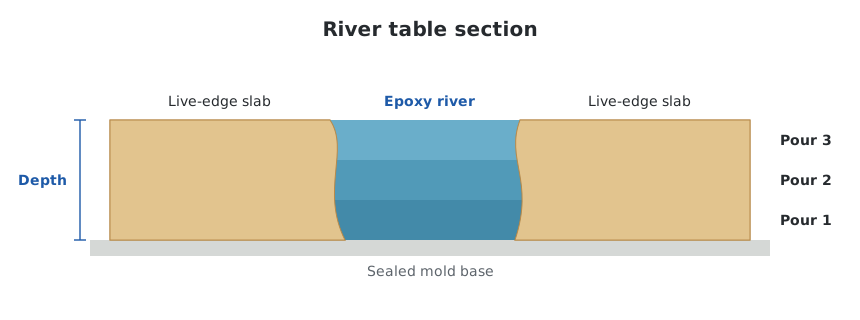
- The result is how much epoxy resin you need, mixed. Add your kit size to see how many kits to buy. The section drawing shows each pour as a layer.
How much epoxy do I need? The formula
Epoxy volume is length × width × depth. Convert cubic inches to gallons by dividing by 231, the number of cubic inches in a US gallon.
Gallons = length (in) × width (in) × depth (in) ÷ 231
Litres = length (cm) × width (cm) × depth (cm) ÷ 1,000
For a round mold, use π × radius² × depth. Then add your waste allowance. Worked example: a river 60 inches long, 6 inches wide on average and 1½ inches deep holds 540 cubic inches, or 2.34 gallons. With 15% extra, buy about 2.7 gallons. With a deep pour epoxy rated for 2 inches, that is one pour. With a ½-inch casting resin, it takes three.
Measuring a live-edge river table
Live edges are irregular, so a single width reading can be off by an inch or more. Lay a tape across the channel every 6 to 12 inches along its length, add the readings, and divide by the number of readings. Use the full slab thickness as depth if the river runs through the whole table, plus any extra height you want to sand back.
Bark pockets, cracks and knots also soak up resin, and so does dry, porous wood. Brush a thin seal coat over the live edges first so the river doesn't bubble as air escapes from the wood. That coat is part of what the waste allowance covers.
Pour depth: why one big pour can fail
Epoxy cures by an exothermic reaction, so it makes its own heat. A thick mass of fast-curing resin can overheat, which causes cracking, yellowing, warping and bubbles. Each product has a maximum layer depth:
| Epoxy type | Typical max per pour | Working time | Common use |
|---|---|---|---|
| Tabletop / coating | about 1/8 in | 20–45 min | Bar tops, seal and flood coats |
| Medium pour / casting | 1/2–1 in | Hours | Small molds, cracks, inlays |
| Deep pour | 2 in or more | Many hours | River tables, thick castings |
| Extra-deep pour | 4 in or more | Up to days | Thick river tables, large castings |
Deeper pours cure slower and are more sensitive to room temperature. Most epoxies want a shop at about 70–80 °F while curing. Wait until the previous layer is firm but still slightly tacky before adding the next, unless your product says otherwise.
Epoxy coverage chart: square feet per gallon
For flat coats and pours it helps to think in coverage. One US gallon is 231 cubic inches, so at a given thickness it covers 231 ÷ (thickness in inches × 144) square feet.
| Thickness | Sq ft per gallon | m² per litre | Typical use |
|---|---|---|---|
| 1/16 in | 25.7 | 0.63 | Thin seal coat (brushed coats are thinner still) |
| 1/8 in | 12.8 | 0.31 | Tabletop flood coat |
| 1/4 in | 6.4 | 0.16 | Two flood coats, shallow inlays |
| 1/2 in | 3.2 | 0.08 | Medium casting pour |
| 1 in | 1.6 | 0.04 | Deep pour layer |
| 2 in | 0.8 | 0.02 | Thick river table layer |
A 72 × 36 in tabletop is 18 square feet, so a 1/8 in flood coat needs 18 ÷ 12.8 = 1.4 gallons before waste. That matches the calculator's rectangle mode.
Volume vs weight: measuring part A and part B
The calculator gives volumes because most kits are mixed by volume. Some brands also print a ratio by weight. Resin and hardener have different densities, so the weight ratio is a different number from the volume ratio. If you mix on a scale, use the weight ratio from that product's data sheet, never the volume ratio. Mixed epoxy weighs roughly 9 to 9.5 pounds per gallon, which is handy when you are checking how much is left in a jug.
Mix ratio: part A and part B
The volume you calculate is the mixed amount. With a 1:1 ratio, half is resin (part A) and half is hardener (part B). With 2:1, two-thirds is resin. Kits are sold by mixed volume, so a "1.5 gallon kit" of 2:1 epoxy is 1 gallon of resin and half a gallon of hardener. Measure by volume unless the label gives a weight ratio, and never swap one ratio for the other.
Epoxy for common projects
| Project | Size | Cubic inches | Gallons | Litres |
|---|---|---|---|---|
| River coffee table | 48 × 5 × 1½ in river | 360 | 1.56 | 5.9 |
| River dining table | 84 × 8 × 2 in river | 1,344 | 5.82 | 22.0 |
| Bar top flood coat | 96 × 24 in at 1/8 in | 288 | 1.25 | 4.7 |
| Dining tabletop coat | 72 × 36 in at 1/8 in | 324 | 1.40 | 5.3 |
| Charcuterie board pour | 16 × 10 × ¾ in mold | 120 | 0.52 | 2.0 |
| Round side table | 24 in diameter × 1 in | 452 | 1.96 | 7.4 |
Tips that save resin
- Build the mold from melamine or HDPE and seal every seam with silicone or tuck tape. Leaks are the biggest source of waste.
- Mix one extra small batch for the seal coat rather than eating into the main pour.
- Don’t run short mid-pour. Having to mix a new batch while a layer is curing leaves a visible line. Round up to whole kits.
- Warm the resin bottles in warm water before mixing to release bubbles, but don't heat a deep pour more than the label allows.
- Pour a little above the slab surface. You will plane or sand it flush.
Frequently asked questions
How much epoxy do I need for a river table?
Multiply the river's length × average width × depth in inches and divide by 231 to get US gallons. A river 60 in long, 6 in wide on average and 1.5 in deep holds 540 cubic inches, or 2.34 gallons. Add 10 to 15 percent for the seal coat, leaks and mixing waste, so buy about 2.6 to 2.7 gallons.
How many cubic inches are in a gallon of epoxy?
A US gallon is 231 cubic inches, which is 3.785 litres. One litre is 61.02 cubic inches.
How thick can I pour epoxy in one layer?
It depends on the product. Tabletop or coating epoxy is usually limited to about 1/8 inch per coat. Medium-pour casting resins handle roughly 1/2 to 1 inch, and deep-pour epoxies are typically rated for 2 inches or more per pour. Pouring thicker than the label allows can overheat, crack or yellow the resin.
How much epoxy do I need to coat a table top?
A 1/8 inch flood coat on a 72 × 36 inch tabletop is 324 cubic inches, or about 1.4 gallons before waste. A seal coat is much thinner. Add extra for drips over the edges.
Should I measure epoxy by volume or weight?
Follow the ratio on your product. A 1:1 or 2:1 ratio is usually by volume. Some resins also give a ratio by weight, which is different because resin and hardener have different densities. Never swap a volume ratio for a weight ratio.
How much extra epoxy should I buy?
Plan on 10 percent extra for a sealed mold with a seal coat, and 15 to 20 percent for live-edge river tables, which soak up resin and can leak through gaps in the mold.
How many square feet does a gallon of epoxy cover?
At 1/8 inch thick, one US gallon of mixed epoxy covers about 12.8 square feet. At 1/16 inch it covers about 25.7 square feet, and at 1/4 inch about 6.4 square feet.